
Contact Info
Orthopaedics & Joint Replacement
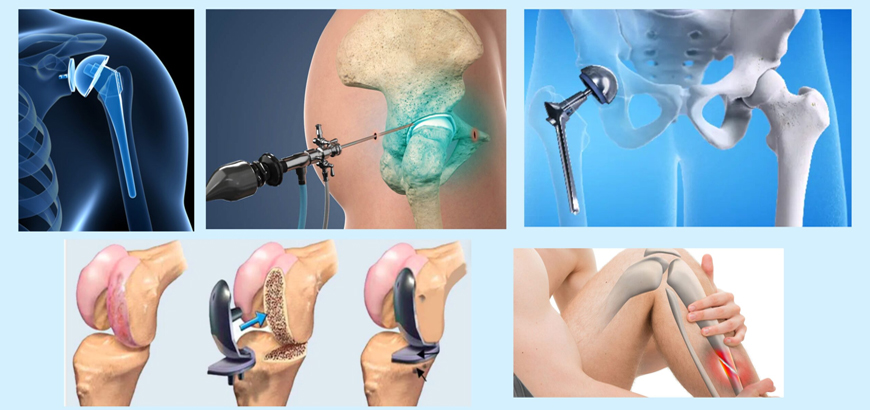
Orthopedic Surgery is the branch of surgery concerned with conditions involving the musculoskeletal system. Orthopedic surgeons use both surgical and nonsurgical means to treat musculoskeletal trauma, spine diseases, sports injuries, degenerative diseases, infections, tumors, and congenital disorders.The word Orthopedics comes from two Greek words, ortho, meaning straight and pais, meaning child. Originally, orthopedic surgeons dealt with bone deformities in children, using braces to straighten the child’s bones. With the development of anesthesia and an understanding of the importance of aseptic methods in surgery, orthopedic surgeons extended their role to include surgery involving the bones and related nerves and connective tissue.
What Types of Surgeries do Orthopaedic Surgeons Perform?
Orthopaedic surgeons perform numerous types of surgeries on patients. The range of treatments done by orthopedists is enormous. It can cover anything from traction to amputation, hand reconstruction to spinal fusion or joint replacements. They also treat broken bones, strains and sprains, and dislocations.
Joint replacements
Joint replacement is a kind of orthopaedic surgery known for restoring freedom of movement and eliminate the pain because of degenerated and diseased joints. Hip and know replacement are the most common ones. Due to technological advancements, now-a-days cementless implants are being used for customized fitting to increase longevity. This surgery might not last long and may need a second chance too.
There are various kinds of joint replacement surgeries:
- Total hip replacement
- Total knee replacement
- Wrist replacement
- Hand joint (small) replacement surgery
- Total shoulder replacement
- Ankle joint replacement
- Total elbow replacement
Arthroscopic (Keyhole) surgery
Arthroscopic surgeries are known as Keyhole surgeries as the incision for the operation is the size of a small hole in the skin. This surgery deals the operations of joints. Recovery in the case of this surgery is much faster in comparison to the traditional surgery. Keyhole surgery can be done in a number of body parts like shoulder, knee, wrist, ankle, and so on. The most performed keyhole surgery is of the knee joints. For a normal arthroscopic surgery, one has to stay in the hospital only for a day or 2 but physical exercise after the surgery is extremely important.
Arthroscopic surgery for problems in knee, shoulder, elbow and ankle, deals with the following:
- Trauma and Fracture surgery
- High quality Swiss ‘AO’ systems help stabilize fractures
- Infected non-union of long bones
- Image intensifier, confirms perfect fracture fixations
Spinal Surgery
All intra-dural spinal surgeries including implant cover all the spinal surgeries carried out to correct a disorder or a disease associated with the spinal nerve or spinal cord. Procedures such as spine fusion surgery with instrumentation and spinal fusion surgery are also included.
Spine surgery includes a number of things:
- Disc surgery Microsurgery for disc Fixation systems for fractures
- Surgery for spinal tuberculosis
- Surgery for correction of spinal deformities
- Endoscopic spine surgery
Arthritis care
Arthritis, is primarily used in describing any kind of wear of cartilage with a number of symptoms like aches, pains and stiffness in joints. Rheumatism is also used for pain in muscles and joints. There are some other terms also used amongst the doctors:
- Osteoarthritis Rheumatoid arthritis
- Infective arthritis
- Traumatic arthritis
Pediatric Orthopedics
Pediatric orthopedics deals in the treatment of every musculoskeletal problem in children, which is inclusive of pediatric trauma, metabolic diseases, congenital malformations, and genetic abnormalities such as club foot, congenital dislocations, pseudarthrosis, birth injuries and other congenital deformities. Following are the included corrections:
- Congenital limb and spinal deformity corrections
- Bone and joint infection management
- Juvenile arthritis management
Ankle Arthrodesis
Nowadays, ankle arthritis has become a common problem. The problem is associated with severe pain and reduced functioning of the ankle. Ankle arthrodesis, also known as ankle fusion, removes ankle bones and then joins them together. The treatment not only alleviates the ankle pain but also eliminates the motion problem of the ankle joint. Thus, the best way to treat ankle arthritis is ankle arthrodesis.
Anterior Cruciate Ligament (ACL) Reconstruction
Anterior Cruciate Ligament (ACL) Reconstruction is a type of surgical tissue graft replacement. The treatment is suggested for restoring the functioning of the knee after surgery. The method is carried out on the anterior cruciate ligament. Though the recovery time for ACL reconstruction is six weeks, it can still take a bit longer. The recovery time clearly depends on the overall health and age of the patient.
Carpal Tunnel Release
Carpal tunnel release is suggested to the patients experiencing Carpal tunnel symptoms. This surgery includes cutting and opening of transverse carpal ligaments which in return alleviates the severe pain of the patient. The affected area takes time to heal after the surgery. The reason for this is that the region remains painful and numb for a few days.
Decompression posterior and fusion spine
Decompression posterior and fusion spine surgery is done to eliminate a part of the bone over the disc material or nerve root. This is in return makes more space at the nerve root. The main aim of the surgery is to guarantee a better healing environment at the nerve root. This surgery is carried out to aid patients in getting relief from pain caused due to the pinched nerves, also known as neural impingement.
Decompression posterior and fusion spine (Level II)
Decompression posterior and fusion spine (level II) proceeds with making a small incision of around 4 – 8 cm at the lower back. The surgery is carried out to fuse lower back at two different levels of the spine. The aim of the surgery is to decorticate transverse processes and facet joints as well. In this method, bone grafts are placed on the sides of the vertebrate.
Disc Replacement (Cervical/Lumbar) Two Levels
Disc Replacement (Cervical/Lumbar) Two-Level is suggested for patients suffering from symptomatic degenerative disc disease. The surgery aids in correcting two adjacently injured cervical discs. The main objective is to replace two problematic discs with two artificial disc devices.
Knee Arthroscopy
The best approach to address any kind of knee problem is Knee arthroscopy. During the surgery, a small incision is made on the knee. This is followed by inserting an endoscope with an attached camera into the knee. Flexible knee movement post-surgery is ensured by restoring the normal joint fluid. The recovery time of the knee arthroscopy is six weeks.
Meniscectomy
A medical condition, Meniscectomy is associated with a torn meniscus in the knee. For meniscus repair, the surgery is a must. The surgery involves operating the torn meniscus and removing it to alleviate the severe pain that the patient is enduring. This surgery is usually performed on the young-age patients. Post the removal of the torn meniscus, the affected area heals up with time. Knee joint replacement is referred for the old-age patients in such cases.
Transforaminal lumbar interbody fusion (TLIF)
TLIF or Transforaminal lumbar interbody fusion is one to fuse the posterior and anterior columns of the spine through spine approach. After the surgery, improvement is apparent in almost 60 to 70 percent of the patients which is really recommendable. The minimally invasive surgical technique is used in TLIF to fuse the bones and helps the patient to recover fast.